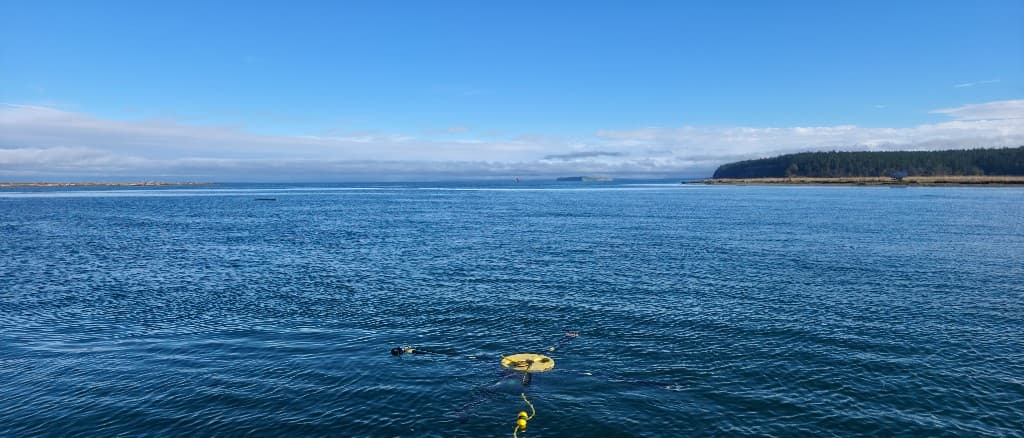
AnchorBot TEAMER Helical Anchors Install & Pull Strength Test Report
AnchorBot Helical Anchor Demonstration
Field Operations Report · 5–8 December 2025 · Sequim, Washington
| Date(s) | 5–8 December 2025 |
|---|---|
| Location(s) | Sequim, Washington and nearby offshore waters |
| On-Site Personnel | Jon Pompa (AnchorBot), Corbin Blanch (AnchorBot), Chris Malzone (Beringia Marine / AnchorBot), Linnea Weicht (PNNL), Spencer Nelson (PNNL), John Vavrinec (PNNL) |
Prepared by: AnchorBot LLC and Beringia Marine
In collaboration with: the Testing Expertise and Access for Marine Energy Research (TEAMER™) program

Executive Summary
From December 5–8, 2025, AnchorBot LLC and Beringia Marine conducted offshore field trials at a TEAMER facility near Sequim, Washington. The objective of the program was to demonstrate the AnchorBot helical anchor installation system and to evaluate the behavior of helical earth anchors under realistic marine conditions relevant to TEAMER projects.
Operations were conducted from a small workboat at two test areas: a 25 m deep Bay site (Site 1) and a shallower, higher-energy 10 m Channel site (Site 2). Prior to anchor installation, AnchorBot was used to obtain sediment core samples at both locations, providing confirmation of seabed conditions and informing subsequent installation activities. Using AnchorBot, both 8-inch and 6-inch helical anchors with 48-inch shafts were installed and subjected to controlled pull testing, including single-pull failure tests, multiple sequential pull tests, and one sustained-load dwell test. Selected anchors were also installed and intentionally left in place with subsurface buoys to allow long-term settlement within the sediment, establishing a pathway for future pull testing following extended embedment periods.
Sediments at both sites consisted primarily of fine silt and consolidated sandy mud with shell fragments, with the Channel site exhibiting higher sand content and a greater presence of stones and shell material at the seabed surface. Installation torque and pull-test data were analyzed using a normalized, event-based framework that aligns installation and pull behavior by mechanical progression rather than time.
Results from both sites indicate that helical anchors do not behave as brittle, single-capacity systems. Instead, resistance is mobilized progressively under applied loading conditions, and repeated pulling did not result in observable degradation of anchor performance. Single-pull failures provided conservative lower-bound estimates of resistance and may under-represent anchor behavior under more representative loading scenarios. The sustained-load dwell test showed no loss of resistance during a twelve-minute dwell period, indicating short-term load stability without evidence of creep-related failure.
Anchor behavior was consistent across both Bay and Channel environments despite differences in water depth and environmental energy. Helix diameter influenced installation torque and resistance mobilization characteristics; however, local sediment conditions exerted a stronger control on performance than geometry alone. Installation torque proved to be a useful qualitative indicator of embedment resistance but was not a reliable predictor of holding resistance in isolation.
Overall, the field trials demonstrate that helical anchors installed using AnchorBot provide a low-impact and resilient anchoring solution capable of sustaining repeated and sustained loading when appropriately matched to site conditions. Anchors intentionally left in place for long-term settlement will be instrumented and subjected to controlled pull testing at six-month and one-year intervals to quantify changes in holding resistance as disturbed sediments reconsolidate and re-establish mechanical soil structure. The resulting time-dependent strength data will support comparative evaluation of anchor performance over extended embedment periods and inform predictive models relating long-term holding behavior to strength measurements obtained immediately following installation.
Project Overview
Between 5 and 8 December 2025, personnel from AnchorBot LLC and Beringia Marine conducted offshore field operations in collaboration with the Testing Expertise and Access for Marine Energy Research (TEAMER™) program at a facility near Sequim, Washington. The program was designed to demonstrate the AnchorBot helical anchor installation system and to evaluate the applicability, performance, and limitations of helical earth anchors for marine infrastructure and research applications relevant to TEAMER™ projects.
The field program addressed both installation and post-installation behavior of helical anchors under realistic marine conditions. Objectives included installation from a small workboat, evaluation of multiple anchor geometries across contrasting sites, characterization of pull resistance immediately following installation, and deployment of selected anchors with subsurface buoys to allow long-term sediment settlement and future testing. Operational, procedural, and logistical observations were also documented to inform future deployments and expanded test programs.
Vessel and Equipment
Vessel Description
All operations were conducted aboard a SAFE boat selected to represent a typical small-vessel platform that could reasonably support AnchorBot operations without specialized infrastructure. The vessel is approximately 31 feet in length with a 10-foot beam and a draft of 22 inches. The hull is constructed of marine-grade 5086 aluminum with a 5/16-inch plating thickness and incorporates a self-bailing design suitable for stationary and low-speed operations.
The vessel is configured with a walk-around cabin and a drop-down bow, providing a forward working deck area approximately 3.5 feet wide by 13 feet long that was used for equipment staging, deployment, and recovery. Propulsion is provided by twin V6 Mercury gasoline engines. Onboard electrical power includes 12 V DC service and 120 V AC supplied via an inverter with standard receptacles.
Lifting and handling operations were supported by a deck-mounted davit equipped with an open block. A crab-puller was used to rapidly incorporate lifting lines as required during anchor deployment and recovery. This vessel configuration proved sufficient for all AnchorBot installation, pull testing, and recovery activities conducted during the project, without the need for barges, cranes, or additional support vessels.
Anchor Types and Test Locations
Anchor Types
Two helical anchor geometries were evaluated during the field program: 8-inch diameter helicals with 48-inch shafts and 6-inch diameter helicals with 48-inch shafts. Both anchor types have a 3 inch pitch and were installed using the AnchorBot system with continuous, real-time torque monitoring during installation. The use of two helix diameters allowed for comparative evaluation of installation behavior and pull resistance while holding shaft length constant.
Test Locations
Two offshore test locations east of Sequim were selected to represent contrasting environmental and operational conditions. The first location, referred to throughout this report as the "Bay" site, is situated in approximately 25 meters of water under relatively sheltered conditions. Sediments at this site consist primarily of fine silt and consolidated sandy mud with shell fragments.
The second location, referred to as the "Channel" site, is situated near the entrance to the bay in approximately 10 meters of water and is characterized by higher-energy conditions. Sediments at the Channel site consist of fine silt and consolidated sandy mud with shell fragments, with a higher clay content relative to the Bay site. In addition, larger shell material and scattered stones were observed at the seabed surface, indicating greater sediment heterogeneity and localized coarse inclusions within the near-surface layer.
At each site, six 8-inch helicals and six 6-inch helicals were installed and left in place with subsurface buoys to allow for long-term settlement and future retrieval. In addition, multiple anchors of both sizes were installed and immediately extracted using lift bags and in-line load cells to measure initial pull resistance. Pull testing was repeated multiple times at both sites to evaluate the effects of sequential loading on anchor performance.
Technical Basis
Helical anchors derive resistance from embedment into surrounding sediments rather than from mass. Installed to a specified torque, the helices engage surrounding soils and develop resistance through bearing and shear along embedded surfaces. In Puget Sound sediments, reconsolidation around embedded helices is expected to further stabilize anchors over time.
Helical anchors resist both vertical and lateral loads, do not drag under tension, and can be bridled to increase effective resistance. Installation torque provides a repeatable and auditable metric for embedment resistance but does not alone define holding capacity.
The AnchorBot System
AnchorBot is a compact, remotely operated system designed to collect core samples and install helical anchors from small vessels in water depths of up to 330 feet. During this project, the system was deployed from a vessel equipped with a simple davit and required no barges, cranes, or diver intervention. Mobilization time was approximately three hours, and the system was operated by a two-person crew.
Once sediment characteristics were confirmed using AnchorBot's coring system, anchor installation proceeded efficiently, with observed installation rates averaging approximately one anchor every 15 minutes. Real-time video and torque feedback were available throughout each installation, providing continuous verification of embedment quality. Although acoustic positioning was not utilized during this project, the AnchorBot system is capable of integrating acoustic navigation to support higher-precision anchor placement where required.
Anchors installed during the program were removed using a 7,200-pound lift bag in combination with an in-line load cell to determine pull resistance and failure behavior. These pull-test data are analyzed later in this report alongside the installation torque data provided by AnchorBot. The system also supports reverse installation for anchor relocation or decommissioning, reducing the likelihood of abandoned infrastructure on the seafloor.
Environmental and Risk Considerations
Environmental Benefits
Helical anchors minimize seabed disturbance, avoid cement and corroding steel, eliminate bottom chain, and reduce benthic abrasion. The AnchorBot system further reduces risk by eliminating diver requirements, minimizing heavy manual handling, preventing anchor drag, and enabling clean decommissioning. The ability to collect sediment cores prior to installation reduces uncertainty and improves placement suitability.
Data Analysis Methodology
Installation torque and pull-test data collected at the Bay (Site 1) and Channel (Site 2) locations were analyzed using a consistent, physics-based framework designed to compare anchor behavior across differing test sequences, sediment conditions, and loading histories. Because installation and pull tests were conducted at different times and rates, direct time-based alignment was not appropriate. Instead, analysis focused on mechanical event progression and resistance mobilization.
Installation torque was recorded continuously during anchor embedment and processed in SI units (newton-meters). For Channel datasets, a known torque zero-offset was corrected prior to analysis. Torque records were segmented from the onset of measurable resistance through peak torque, representing the effective embedment phase of the anchor. Peak torque was treated as the point at which the anchor achieved its final installed state.
Pull-test data were recorded using load cells, with raw values provided in pounds-force and converted to newtons for analysis. For all pull datasets, the third column of each file was treated as the valid force measurement. Each pull record was processed to identify the onset of meaningful resistance, excluding slack, seating effects, and low-level sensor noise. Pull onset was defined algorithmically as a sustained increase above baseline noise with a positive slope, under the assumption that this point corresponds to initial soil–anchor engagement rather than test setup artifacts.
To enable comparison between installation and pull behavior, both datasets were mapped to a normalized event progression scale from zero to one. For installation torque, zero corresponds to the onset of resistance and one corresponds to peak torque. For pull tests, zero corresponds to detected pull onset and one corresponds to peak pull force. Pull curves were aligned to begin at approximately sixty percent of the normalized progression, reflecting the physical sequence in which pull resistance develops after installation is complete. This approach allows comparison of mechanical behavior rather than absolute time (Fig 1).

Figure 1. Normalized installation torque and pull force for a representative 8-inch helical anchor at Site 1 (Bay). Installation torque is shown in blue and pull force in orange. Data are aligned by mechanical event progression rather than time, with torque spanning from onset of resistance to peak embedment and pull force spanning from detected pull onset to peak resistance. This normalization framework is used consistently for all anchors and sites.
For anchors subjected to multiple pull tests, each pull was treated as a distinct loading event acting on an anchor–sediment system that had been modified by prior loading, and pull results were therefore not averaged. Successive pulls can alter soil structure, load paths, and force transmission, so pull sequences were evaluated to characterize how resistance was mobilized under repeated loading rather than to define a single capacity value. Anchors subjected to a single pull that resulted in failure were treated as providing conservative lower-bound estimates of resistance. One anchor was subjected to a sustained-load dwell period, during which pull force was held approximately constant for twelve minutes; this test was analyzed separately to assess short-term load stability and potential creep behavior (Fig. 2). Although sequential pull tests were conducted using consistent equipment and procedures, measured pull resistance may be influenced by factors such as load alignment, line handling, and force application efficiency; accordingly, increases in measured pull force between successive pulls are interpreted as differences in resistance mobilized under the applied loading conditions, rather than as definitive evidence of an increase in the intrinsic strength of the anchor–sediment system.

Figure 2. Sequential pull tests performed on a single 8-inch helical anchor at Site 1 (Bay). Pull resistance increases with successive pulls (Pull #1 through Pull #3), demonstrating progressive mobilization of soil resistance rather than degradation. Installation torque is shown in blue; pull tests are shown in sequential warm colors. NOTE: Installation torque reflects embedment resistance during installation and is not expected to correlate directly with pull resistance measured during post-installation loading.
The apparent disconnect between installation torque and pull resistance shown in Figure 2 arises from the fact that these measurements characterize fundamentally different physical processes. Installation torque reflects the resistance encountered during anchor embedment, which is influenced by operator-controlled installation rate, frictional drag, and transient interactions with localized sediment features such as shells or coarse inclusions. As a result, peak torque does not directly represent the fully developed bearing resistance of the surrounding soil mass. In contrast, pull tests measure the resistance mobilized under tensile loading after installation is complete. The observed increase in peak pull force across successive pulls therefore reflects improved engagement of the anchor with the surrounding sediment, including seating, load alignment, and redistribution of stresses within the soil. Early pull attempts may not fully mobilize available resistance due to initial disturbance or suboptimal loading conditions, whereas later pulls more effectively engage the anchor–sediment system. Consequently, the increase in pull resistance with successive pulls is not inconsistent with variations in installation torque, but instead highlights the difference between embedment mechanics and post-installation load transfer behavior.
All datasets from both sites were processed using identical algorithms, thresholds, unit conversions, and visualization methods to ensure direct comparability.
Assumptions
The analysis assumes that installation torque provides a qualitative indicator of embedment resistance but is not, by itself, a direct predictor of holding capacity. It is further assumed that the detected pull onset accurately isolates meaningful soil–anchor interaction and that peak pull force represents the maximum mobilized resistance for a given pull event. Sequential pulls are assumed to modify the anchor–sediment system and therefore reflect progressive behavior rather than repeat measurements of an unchanged state. Results are interpreted as behavioral characterization rather than certified design capacities.
Results
Bay (Site 1)
At the Bay site, anchors were tested using both 8-inch and 6-inch helicals, all with 48-inch shafts. The 8-inch helicals (Anchors 1 through 7) exhibited three distinct test outcomes depending on loading sequence and test execution. Several anchors subjected to multiple pull tests exhibited higher peak pull forces in later pulls compared to earlier attempts. While this pattern is consistent with progressive mobilization of resistance, it is important to note that the observed increase in measured pull force may also reflect improvements in load application, test setup, or force alignment between successive pulls rather than a change in the intrinsic strength of the anchor–sediment system. As such, the data demonstrate that early pull tests can under-represent mobilized resistance, but they do not, by themselves, establish that anchor capacity increases with repeated loading.
Anchors subjected to a single monotonic pull failed without opportunity for reloading or refinement of test conditions. These results are therefore interpreted as conservative lower-bound estimates of anchor resistance rather than definitive measures of ultimate capacity (Fig. 3). For Site 1, Anchor 4, it should be noted that the load cell exhibited a sensor fault that introduced a magnitude bias in the recorded values. While the overall shape and progression of the pull curve remain indicative of anchor behavior, the absolute force values should not be considered precise representations of actual holding resistance. In all cases, the ultimate holding strength of an anchor is only known once failure is achieved; until that point, measured pull forces reflect the resistance mobilized under the specific loading conditions and instrumentation constraints present during testing.

Figure 3. Installation torque and single monotonic pull response for an 8-inch helical anchor at Site 1 (Anchor 4). The anchor was subjected to a single pull event that resulted in failure, and no subsequent pull tests were performed. The measured peak pull therefore represents a conservative lower-bound estimate of mobilized resistance rather than fully characterized capacity. It should be noted that the load cell used during this test exhibited a sensor fault that biased the magnitude of the recorded pull force; while the overall trend of the pull curve reflects anchor behavior, absolute force values should be interpreted with caution.
One 8-inch anchor was subjected to a twelve-minute dwell period at approximately constant load. No reduction in resistance was observed during this interval, and pull resistance increased following the dwell. This indicates short-term stability under sustained loading and an absence of creep-driven degradation within the tested timeframe (Fig 4).

Figure 4. Normalized installation torque and pull force for Anchor 7 at Site 1, which was subjected to a 12-minute dwell period at approximately constant load. No reduction in resistance was observed during the dwell interval, and pull resistance increased following the dwell, indicating short-term load stability and absence of creep-driven degradation.
The 6-inch helicals tested at the Bay site (Anchors 8 and 10) exhibited lower installation torque than the 8-inch anchors, as expected given reduced bearing area. Despite this, both anchors mobilized pull resistance smoothly and monotonically, with no evidence of abrupt instability or premature failure. While absolute capacity differed between anchors, the observed behavior indicates that 6-inch helicals can provide stable holding performance under suitable sediment conditions (Fig 5).

Figure 5. Normalized installation torque and pull force for a 6-inch helical anchor with a 48-inch shaft at Site 1. Compared to 8-inch helicals, installation torque is reduced as expected, while pull resistance is mobilized smoothly and monotonically. Results indicate stable holding behavior despite reduced helix diameter.
Channel (Site 2)
At the Channel site, a single 8-inch helical anchor with a 48-inch shaft was subjected to three sequential pull tests. As observed at the Bay site, higher peak pull forces were measured in later pull attempts relative to earlier tests. The first pull mobilized the lowest resistance and is interpreted as reflecting initial seating of the anchor–sediment system and the applied loading conditions during that test. Subsequent pulls achieved higher measured resistance, with no evidence of sudden loss of load-carrying capability or instability. The anchor exhibited a ductile response, maintaining resistance under increasing load rather than failing abruptly.
Despite differences in water depth and environmental energy between the Bay and Channel sites, the mechanical response observed during sequential pull testing was consistent across both environments. In each case, repeated loading did not result in progressive weakening of the anchor–sediment system, and variations in measured pull resistance are interpreted in accordance with the sequential pull test methodology described in the Methods section, reflecting differences in resistance mobilized under the applied loading conditions rather than changes in intrinsic anchor capacity.

Figure 6. Normalized installation torque and sequential pull tests for a single 8-inch helical anchor installed at the Channel site (Site 2). Installation torque is shown in blue, while three successive pull tests are shown in orange, red, and purple. Higher peak pull forces were measured in later pull attempts relative to earlier tests. In accordance with the sequential pull test methodology, these differences are interpreted as reflecting variations in resistance mobilized under the applied loading conditions rather than degradation of anchor performance or an increase in intrinsic anchor capacity, despite the shallower water depth and higher-energy environmental setting.
Cross-Site Interpretation
Across both sites, the data indicate that helical anchors do not behave as brittle, single-capacity devices. Instead, resistance is mobilized progressively under applied loading conditions, and repeated pulling did not result in observable degradation of holding performance. Single-pull tests provide conservative lower-bound estimates of resistance and may under-represent anchor behavior under more representative loading scenarios, while multi-pull and sustained-load tests offer a more complete characterization of anchor–sediment interaction. Installation torque alone was not a reliable predictor of pull resistance, with local sediment structure and loading conditions exerting a dominant influence on observed performance.
Taken together, these results demonstrate consistent and resilient anchor behavior across differing environments and loading histories, supporting the suitability of helical anchors for applications involving repeated or sustained loading when appropriately matched to site conditions and interpreted within the context of the applied test methodology.

Figure 7. Side-by-side comparison of representative 8-inch helical anchors tested at the Bay (Site 1) and Channel (Site 2). Both plots use identical normalization, scaling, and visualization conventions. Despite differences in water depth and hydrodynamic setting, both anchors exhibit ductile behavior and progressive resistance mobilization, indicating consistent anchor performance across environments.
Discussion
Results from the Bay (Site 1) and Channel (Site 2) testing programs indicate that helical anchor behavior in the tested sediments is governed by how resistance is mobilized under applied loading conditions rather than by a single, brittle failure threshold. Across both sites, sequential pull tests produced higher measured peak pull forces in later pull attempts relative to earlier tests. Early pulls are interpreted as reflecting initial system seating, load alignment, and sediment disturbance under the specific loading conditions applied during those tests rather than fully developed anchor–sediment interaction. Consequently, single-pull tests tend to provide conservative lower-bound estimates of resistance and may under-represent anchor behavior under more representative loading scenarios.
Anchors that failed during a single monotonic pull exhibited distinctly different outcomes. These tests provide conservative lower-bound resistance values but do not capture the broader range of resistance that may be mobilized when loading conditions or test execution are refined through subsequent pulls. Importantly, single-pull failures did not indicate inherent instability of the anchor–sediment system; rather, they underscore the sensitivity of measured pull resistance to loading sequence, force alignment, and test execution. This distinction is critical when interpreting field pull-test results for design evaluation or regulatory review.
Interpretation of installation torque data from the AnchorBot system requires consideration of several system-specific factors that differ from traditional terrestrial helical anchor installation measurements. AnchorBot is remotely operated, and the operator has immediate control from zero to full throttle. Applied torque can therefore vary instantaneously during installation. The torque recorded at any moment reflects not only soil resistance and embedment depth, but also operator input and installation rate. A portion of the measured torque is associated with frictional resistance that is velocity dependent; consequently, torque varies as a function of soil properties, depth, and rotational speed. In addition, localized inclusions such as rocks, larger shells, or coarse fragments can generate momentary torque spikes that are not representative of the bulk sediment properties. These transient spikes are typically excluded when evaluating torque as an indicator of overall embedment resistance. An exception occurs when deliberate torque pulsing or dynamic hammering is used to advance an anchor that exceeds the system's maximum sustained torque capability in relatively homogeneous sediment. In such cases, torque peak values associated with intentional pulsing may represent the effective installation demand required to overcome static resistance.
Installation torque and pull resistance should not be interpreted as directly correlated metrics, as they represent different phases of anchor behavior. Installation torque reflects embedment resistance under operator-controlled installation conditions and is influenced by rate effects, frictional drag, and localized sediment variability. In contrast, pull resistance reflects the mobilized tensile capacity of the anchor–sediment system after installation is complete. As a result, variations or even reductions in peak torque do not imply reduced anchor performance. The observed increase in pull resistance across successive pulls is therefore interpreted as improved mobilization of available resistance under refined loading conditions, rather than a change in the intrinsic strength of the sediment or anchor system.
The sustained-load dwell test conducted at the Bay site provides additional insight into short-term, time-dependent behavior. During the twelve-minute dwell period at approximately constant load, no reduction in measured pull resistance was observed. Resistance increased following the dwell interval under continued loading. While longer-duration testing would be required to characterize long-term creep behavior, the observed response indicates short-term load stability and an absence of creep-driven degradation within the time scales evaluated, supporting the suitability of helical anchors for applications involving sustained or cyclic loading.
Comparison between the Bay and Channel sites reveals consistent mechanical response despite differences in water depth, environmental energy, and sediment heterogeneity. At both sites, repeated loading did not result in progressive weakening of the anchor–sediment system, and measured differences in pull resistance between successive pulls are interpreted as differences in resistance mobilized under the applied loading conditions. This consistency across sites suggests that the observed behavior reflects fundamental anchor–sediment interaction rather than site-specific anomalies.
From a practical perspective, these results indicate that single-pull testing alone may not provide a representative assessment of anchor performance, particularly in recently disturbed sediments. Multi-pull and sustained-load testing provide a more complete characterization of how resistance is mobilized under realistic loading conditions. For design and verification purposes, reliance on single monotonic pull tests may lead to conservative estimates of performance, whereas sequential or sustained loading better reflects in-service behavior for applications involving cyclic or transient loads.
Helix diameter influenced installation torque and resistance mobilization characteristics, as expected. The 6-inch helicals generally exhibited lower installation torque than the 8-inch helicals, reflecting reduced bearing area. Nevertheless, the 6-inch anchors mobilized pull resistance smoothly and monotonically, with no evidence of abrupt instability or premature failure. These results indicate that reduced helix diameter does not inherently compromise anchor stability, although absolute resistance remains sensitive to local sediment conditions.
Across all anchors and both sites, installation torque alone was not a reliable predictor of pull resistance. Anchors with similar torque values exhibited differing pull responses, highlighting the dominant influence of local sediment structure, layering, disturbance history, and loading conditions. Installation torque remains a useful qualitative indicator of embedment resistance but should not be used in isolation to infer holding capacity.
Collectively, the results demonstrate that helical anchors installed using the AnchorBot system exhibit ductile and resilient behavior under repeated and sustained loading, with no evidence of progressive degradation across the tested conditions. The findings support the use of multi-pull and sustained-load testing as more informative approaches for characterizing anchor behavior than single-pull tests alone, provided that both pull data and installation torque are interpreted within the context of system dynamics, sediment variability, and applied loading conditions. These findings demonstrate that anchor performance is governed by resistance mobilized under representative loading conditions, and should not be inferred from installation torque or single monotonic pull tests alone.
Conclusions
Results from testing at both the Bay and Channel sites demonstrate that helical anchors do not behave as brittle, single-capacity systems. Instead, resistance is mobilized progressively under applied load, and repeated pulling did not result in observable degradation of anchor performance. Single-pull tests yielded conservative lower-bound estimates of resistance and may significantly under-represent anchor behavior under more representative loading conditions. Anchors subjected to sustained loading maintained resistance without evidence of short-term creep-related failure. Observed increases in peak pull force during sequential pull tests are interpreted as reflecting differences in resistance mobilized under the applied loading conditions and test execution, rather than an increase in the intrinsic capacity of the anchor–sediment system.
Installation torque alone was not a reliable predictor of pull resistance across anchors or sites, with local sediment variability exerting a dominant influence on performance. Both 8-inch and 6-inch helical anchors exhibited stable and predictable behavior, with helix diameter influencing installation torque and resistance mobilization characteristics but not fundamentally altering anchor stability.
The consistency of anchor behavior observed across sites with differing depths and environmental energy conditions strengthens confidence in the applicability of helical anchors for mooring, aquaculture, and other subsea infrastructure applications involving repeated or sustained loading. Taken together, these results support the use of helical anchors as a low-impact and reliable alternative to traditional anchoring systems when appropriately matched to site conditions and supported by installation and testing practices that account for site-specific variability.
Future Work
The results presented in this report characterize the short-term installation and pull performance of helical anchors under controlled field conditions. Several important areas of follow-on work have been identified to further strengthen understanding of anchor behavior and to extend the applicability of these findings to long-term marine infrastructure deployments.
A primary next step is the retrieval and pull testing of anchors that were installed and left in place at both the Bay and Channel sites. These anchors were intentionally deployed with subsurface buoys to allow for long-term settlement within the sediment. Future pull testing of these anchors will provide critical insight into time-dependent changes in holding resistance and will allow direct comparison between anchors extracted immediately after installation and those allowed to consolidate over periods of months. This comparison is particularly relevant for applications where anchors are expected to remain loaded for extended durations.
Additional testing across a broader range of environmental conditions would further improve confidence in the generality of the observed behaviors. This includes deployments in areas with different sediment compositions, such as softer silts, denser sands, or layered substrates, as well as testing under varying current regimes and wave exposure. Expanded testing would help refine expectations for installation torque ranges, resistance mobilization behavior, and variability associated with site conditions.
Longer-duration sustained-load tests are also recommended to better assess creep behavior and load stability over time scales beyond those evaluated in this study. While the twelve-minute dwell test demonstrated short-term stability, extended dwell periods would be valuable for applications involving permanent or semi-permanent moorings.
Finally, integration of higher-resolution positioning data during installation, such as acoustic positioning, would support more precise documentation of anchor placement and facilitate repeat testing or retrieval. Coupling anchor performance data with geotechnical sampling or in situ sediment characterization would further improve interpretation of observed variability in anchor behavior.
Recommendations
Based on the field operations, data analysis, and observed anchor behavior documented in this report, several practical recommendations are offered to guide future deployments and testing programs.
From an operational standpoint, rope management emerged as a recurring consideration. Increasing rope inventory and adopting dedicated rope storage solutions would reduce deck congestion and improve efficiency, particularly during sequential pull testing and anchor retrieval operations. Clear labeling and segregation of working lines are recommended to minimize handling errors under dynamic offshore conditions.
Formalization of pre-deployment checklists is strongly recommended. These checklists should explicitly address anchor identification and numbering, coordinate and time logging procedures, and hardware usage constraints, including clear guidance on components that are not rated for lift-bag or pull-test loads. Continued use of a single individual responsibility for timekeeping and position logging during deployments will continue data consistency and reduce post-processing effort.
From a testing and interpretation perspective, reliance on single-pull tests alone is not recommended for characterizing anchor performance. Where feasible, multi-pull testing should be incorporated to capture progressive resistance mobilization and to avoid underestimating anchor capacity. Sustained-load tests should also be included when evaluating anchors for applications involving long-duration or cyclic loading.
Installation torque should continue to be recorded and documented as a qualitative indicator of embedment resistance, but it should not be used in isolation to infer holding capacity. Pull-test data, loading history, sediment composition and site conditions must be considered together when assessing anchor performance.
Finally, lessons learned from this project should be incorporated into AnchorBot standard operating procedures, including guidance on deployment sequencing and data logging discipline. Doing so will improve efficiency, repeatability, and data quality in future campaigns while further reducing operational risk. Collectively, the results and recommendations from this study provide a strong technical foundation for continued evaluation and application of helical anchors installed using AnchorBot across a range of marine environments.
Acknowledgements
This material is based upon work supported by the U.S. Department of Energy's Office of Critical Minerals and Energy Innovation (CMEI) under the Hydropower and Hydrokinetic Office Award Number DE-EE0008895.
Disclaimers
This report was prepared as an account of work sponsored by an agency of the United States Government. Neither the United States Government nor any agency thereof, nor any of their employees, makes any warranty, express or implied, or assumes any legal liability or responsibility for the accuracy, completeness, or usefulness of any information, apparatus, TEAMER Program Special Terms and Conditions product, or process disclosed, or represents that its use would not infringe privately owned rights. Reference herein to any specific commercial product, process, or service by trade name, trademark, manufacturer, or otherwise does not necessarily constitute or imply its endorsement, recommendation, or favoring by the United States Government or any agency thereof. The views and opinions of authors expressed herein do not necessarily state or reflect those of the United States Government or any agency thereof.
This report was prepared independent of the TEAMER reporting process. The Anchorbot and PNNL project teams will make publicly available on MHKDR a final Post Access Report (PAR), along with the data collected during this investigation, at the close of the project.
Appendix 1: Field Operations Summary
December 5, 2025 – Mobilization and Initial Operations. Focus: mobilization and system setup. Departed dock and transited to site; established vessel position using a two-point anchoring configuration; initiated AnchorBot deployment activities; conducted early procedural observations. Key takeaway: Day 1 served as a shake-down period for logistics, vessel configuration, and coordination between deck and subsea operations.
December 6, 2025 – Anchor Deployment and Troubleshooting. Focus: anchor installation and procedural refinement. Installed anchors at multiple logged coordinates; one anchor was lost and documented with position data; adjustments made to rope handling and deployment sequencing. Key takeaway: clear deployment sequencing and adequate rope inventory are critical to smooth offshore operations.
December 7, 2025 – Procedural Refinement and Data Quality. Focus: data consistency and documentation. Continued anchor installations and repositioning; identified duplicate coordinate entries; flagged one anchor for exclusion from analysis; reinforced logging discipline for time and position data. Key takeaway: consistent data logging is essential for downstream analysis and reporting.
December 8, 2025 – Wrap-Up and Lessons Learned. Focus: final operations and documentation. Completed remaining installation and testing activities; identified improvements related to rope storage and hardware selection; captured administrative and documentation notes. Key takeaway: operational objectives were met, with clear opportunities identified for increased efficiency and safety in future deployments.
Appendix 2: Individual plots of Anchor Pull Tests
Representative normalized torque and pull-force plots for the anchors discussed in this report are provided as Figures 1–7 in the Results and Cross-Site Interpretation sections above.